Heathman: An Elegant Script Font for Handmade Brands
As a maker who designs printable wall art, sews boutique gift tags, and prints custom candle labels for my Etsy shop, I know how much weight the right font carries—not just in aesthetics, but in perceived quality and customer trust. That’s why Heathman has become one of my most-used script fonts from the Script Amp collection. It’s not just decorative; it’s purpose-built for crafters who need elegance *and* practicality.
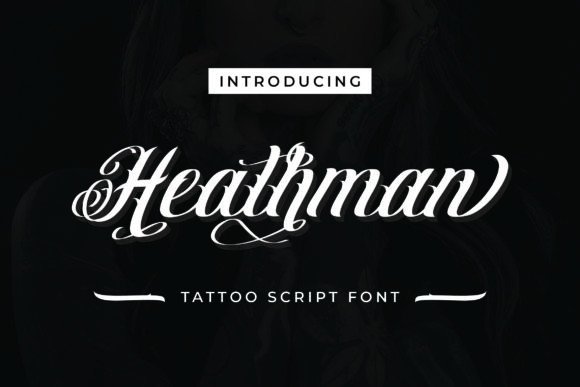
Heathman is a graceful, slightly elevated script font—think calligraphic flow with refined spacing and gentle contrast between thick and thin strokes. It’s not overly ornate, so it avoids looking dated or fussy on physical products. Instead, it brings warmth and intentionality: the kind of handwriting you’d imagine on a hand-lettered wedding welcome board or a small-batch soap label tucked into a curated gift box.
I use Heathman across dozens of product types—each time adjusting size, spacing, and pairing to match the medium. For candle and skincare labels, I set Heathman at 14–18 pt for brand names (like “Wild Sage Co.”) over clean sans serif body text. Its legibility holds up beautifully when printed at small sizes on matte kraft stickers—even down to 10 pt on 1.5” round labels. On my Cricut, I convert Heathman to outlines before cutting vinyl, and its smooth curves cut cleanly without jagged joins or stray nodes.
For wedding stationery, Heathman shines as a display font for couple names, ceremony titles, and menu headers. I’ve used it on foil-stamped invitation suites, digital-printed RSVP cards, and even chalkboard-style welcome signs—always pairing it with a crisp, low-contrast sans serif like Montserrat or Poppins for balance. The contrast keeps information scannable while letting Heathman carry emotional resonance. Guests don’t just read “Emma & James”—they *feel* the care behind it.
It’s also my go-to for seasonal product packaging: think holiday mugs with “Cozy Nights” in Heathman across the front, or spring tote bags stamped with “Bloom Local.” Because Heathman includes standard ligatures and stylistic alternates (like a swash capital “H” or flowing “&”), I can add subtle personality without sacrificing consistency. And yes—it works in SVG files for Silhouette Studio and Cricut Design Space. I export each alternate as its own layer for precise placement on layered cut files.
Readability matters most when scaling down. Heathman isn’t designed for long paragraphs—but that’s not its job. It’s a display font, meant for names, titles, short phrases, and focal points. On planner inserts or printable wall quotes, I keep lines under six words and increase letter-spacing by 20–30 units to prevent visual crowding. For mockup previews (especially on Canva or Placeit), I always test at 75% zoom—what looks lush at full size can blur or merge on mobile screens or printed thumbnails.
Font pairing is where Heathman truly earns its place in my design toolkit. I almost always pair it with a neutral, highly legible companion: a warm sans serif for modern handmade brands, or a soft serif like Merriweather for vintage-leaning stationery. Avoid pairing it with other scripts—that dilutes clarity and weakens brand voice. Instead, let Heathman be the expressive voice, and its partner the trustworthy anchor.
Practically speaking, Heathman comes in OTF and TTF formats—both fully compatible with Adobe Creative Suite, Affinity apps, Cricut Design Space, and Silhouette Studio. It supports Latin-based languages (English, Spanish, French, German) and includes OpenType features like discretionary ligatures, contextual alternates, and swash capitals. No extra plugins needed—I access them directly through the Glyphs panel in Illustrator or the Character panel in Affinity Designer.
One thing I always double-check before launching any product: commercial licensing. Heathman is a commercial font, meaning I’m cleared to use it on physical goods I sell (stickers, mugs, apparel), digital downloads (planner pages, Canva templates), SVG cut files, and client projects—no royalties, no restrictions beyond the standard EULA. That peace of mind lets me invest confidently in design assets that grow with my shop.
In my day-to-day, Heathman shows up on farmhouse-style wooden signs (“Gather Here”), hand-stamped leather tags for jewelry lines, digital printables like baby milestone cards, and even embroidered patches (traced from vectorized Heathman outlines). Each time, it elevates the piece—not by shouting, but by whispering craftsmanship.
What makes Heathman different from other script fonts I’ve tried? It balances expressiveness with restraint. You won’t find chaotic flourishes or inconsistent stroke weights that break on small cuts or fade in print. Every glyph feels intentional, every curve calibrated for real-world production. That’s rare—and invaluable—when your livelihood depends on consistent, beautiful output.
If you’re building a handmade brand where typography quietly signals quality—whether you’re designing for Instagram posts, printable planners, boutique packaging, or laser-cut signage—Heathman fits seamlessly into your workflow. It’s not just another creative font. It’s a reliable, elegant tool—one that helps your customers see your care, before they even read a word.